Is a Personal Trainer Worth It? An Honest Breakdown
Sometimes. The research is clear that supervised training produces bigger strength gains and better attendance than training alone, and the effect on body composition is small. If you already train consistently and progress on your own, a trainer is a luxury. If you stall, skip, or guess, it is probably the best money you will spend.
I own a training studio in Edmonton, so I have an obvious bias. I am going to argue against myself anyway, because the fastest way to earn a bad review is selling coaching to someone who did not need it.
Key Takeaways
- Supervision reliably improves strength, a moderate effect across 12 studies, but its effect on body composition is close to nothing (Fisher et al., 2022).
- The mechanism is unglamorous: people training alone pick lighter weights and stop sets earlier than they think.
- Adherence is where coaching earns its keep. In a 2025 trial, 88.2% of supervised trainees completed at least 85% of their sessions, against 52.2% of those working from a self-guided plan (J Strength Cond Res, 2025).
- If fat loss is your only goal, a trainer is not the highest-leverage purchase. Your food is.
- Coaching is not a cure for quitting. Even in supervised small-group programs, only about half of people remain at 12 months (Front Public Health, 2026).
What does the research actually say about training with a trainer?
It says supervision helps, moderately, and mostly for strength. A meta-analysis of 12 studies covering 301 supervised and 276 unsupervised participants found a moderate effect favouring supervision for strength, a small effect for general performance, and a trivial effect for body composition. That last one is what most studios leave out.
The most-cited trial gave two groups of moderately trained men the identical 12-week periodized program, one with a trainer present and one without. The supervised group raised their loads faster and finished with significantly greater maximal squat and bench press strength (Mazzetti et al., 2000). A commercial gym study found the same pattern in untrained members: those assigned a trainer gained 1.3 kg of lean body mass while the self-directed group gained none, and improved chest press strength 42% against 19% (Storer et al., 2014).
Now the caveat that keeps me honest. In the 2025 trial of already-trained adults, the self-guided group still added 0.9 kg of muscle over 10 weeks. Less than supervised, but not zero. People training alone are not wasting their time.
Why supervision works: load, effort, and showing up
Coaching does not work because trainers know a secret exercise. It works because three ordinary things go wrong when nobody is watching: you pick weights that are too light, you stop sets before you are near your limit, and you skip more sessions than you would admit. Fix those three and most of the gap closes.
On load: a review of 18 studies covering 359 people found participants left to choose their own weights averaged 53% of their one-rep max, which the authors judge workable for muscle growth but likely too light for optimal strength (Steele et al., 2022).
On effort: even experienced lifters misjudge how close they are. Told to take a set to the point they could not do another rep, trained people stopped around two repetitions early (Armes et al., 2020). Two reps sounds trivial. Repeated across every set, every week, for a year, it is not.
On attendance: the biggest lever. In the 2025 trial, 88.2% of the supervised group finished at least 85% of their sessions, against 52.2% of the self-guided group. Same program, same exercises, and barely half the people left to themselves saw it through.
How much supervision also matters. When 124 untrained men trained 11 weeks at a 1:5 or a 1:25 coach-to-trainee ratio, the closely supervised group gained 15.9% on bench press against 10.22%, and was the only group to significantly improve knee extensor strength (Gentil and Bottaro, 2010). That is largely why we built MOV-U around semi-private personal training.
Who gets the most value from a personal trainer?
Four groups, in my experience and in the data: complete beginners with no reference point for effort, people who have plateaued despite training consistently, people returning after injury, illness or a long gap, and people who know from honest self-assessment that they will not show up alone. If that is you, the value is high.
Beginners get the most because they have the most technical ground to cover and the least calibration. They are exactly the population picking 53% of their max and believing it is hard.
Plateaued lifters are second. If you have trained two years and your numbers have not moved in eight months, you do not need motivation. You need someone to look at your program and your execution and say which one is the problem.
Then the accountability group, and I want to be blunt here. Statistics Canada found 39% of Canadian adults did strength training at least twice a week in 2022 to 2024, and 46% met overall physical activity recommendations (Statistics Canada, 2025). Most people who intend to train do not. Paying for a scheduled appointment with someone waiting for you is a legitimate fix, and no shame in buying it.
Who should not hire a personal trainer?
If any of these describe you, save your money. You already train three or more times a week without prompting. You follow a program and your loads are still climbing. Your main goal is fat loss and your nutrition is a mess. Your budget is tight enough that a package would create real financial stress.
Take the fat loss one seriously, because it is the most common reason people call us and the place where an honest answer costs me money. The supervision meta-analysis found a trivial effect on body composition, 0.07, with a confidence interval crossing zero. Supervision does not drive fat loss. Energy intake does. If your food is unmanaged, a nutrition-first approach will do more in three months than a trainer standing beside you while you squat.
The self-sufficient lifter is second. If you own a program and progress on it, coaching is optimization, not necessity. Fine thing to buy, but call it what it is.
Third, financial strain. Training is a repeat purchase, and a package you resent paying for will not survive month three. If the money is not there, train at a gym, follow a free structured program, and revisit later. We would rather you come back in a year than sign something uncomfortable now. For the neutral comparison, we wrote up a trainer against a plain gym membership.
Fourth, and this one is on our industry: if you are not willing to be coached, do not hire a coach.
Does a trainer actually prevent injuries?
Probably somewhat, though this gets oversold. Strength training is already one of the safer things you can do with your body. A systematic review of injury rates across resistance training styles found traditional strength training had the lowest injury prevalence of any style reviewed, around 12.6%, well below what most field and contact sports report.
So the honest framing is not “lifting is dangerous and a trainer keeps you safe.” What a coach realistically does is reduce the avoidable stuff: loading a movement you cannot yet position properly, adding weight faster than your tissue adapts, and grinding through pain that should have changed the plan. The same review notes heavy lifting stays low-risk precisely because it demands good technique, which argues for having your technique watched rather than fearing one bad rep.
Returning from a diagnosed injury, a trainer complements a physiotherapist rather than replacing one. Get cleared first.
Is semi-private training a reasonable middle ground?
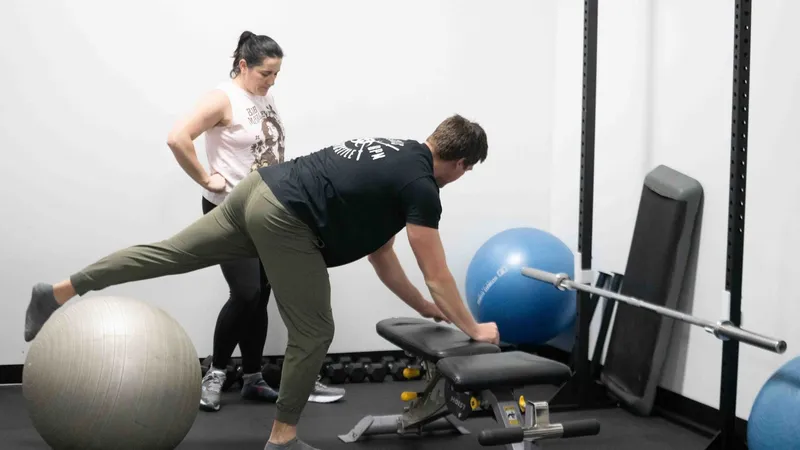
For a lot of people, yes. Semi-private sits between one-on-one coaching and a group class: you train alongside a few other people, but on your own program with a coach present. You get most of the supervision effect at lower cost than private sessions, plus a social layer private training lacks.
The supervision-ratio research is the strongest argument for the format. Close supervision beat distant supervision substantially, but the closely supervised condition in that study was 1:5, not 1:1. You do not need a coach’s undivided attention to capture most of the benefit. You need a coach who can actually see you.
The social component is not fluff either. Attendance decides outcomes, and training with familiar faces on a fixed schedule protects attendance. We covered what semi-private training actually is separately, and what personal training costs in Edmonton handles the money side.
Should you ask about certifications?
Yes, and you should ask us too. In Alberta, personal training is listed as “Not regulated” on the provincial occupational profile. Certification is an industry norm, not a legal requirement, which means anyone in this province can print a business card that says personal trainer and start selling sessions tomorrow.
That is uncomfortable for studio owners to publish, so most do not. It is also the single most useful thing a prospective client can know. Ask any trainer you are considering, including our trainers, what they hold and when they earned it. A good coach answers plainly, and adds liability insurance and current first aid unprompted. Anyone who gets defensive has answered it.
How do you know if you are getting your money’s worth?
Four checks, applied at the 8 to 12 week mark. Are the numbers on your program going up? Can you explain why you are doing what you are doing? Are you attending more consistently than you did alone? Does your coach change the plan when something is not working?
If your loads have not moved in two months and nobody has adjusted anything, you are paying for supervision without programming. The strength research is built on progressive loading, and a coach not tracking progression is not delivering what the evidence supports.
The comprehension test matters more than people expect. Good coaching should make you more independent, not less. Somewhere between month six and month eighteen you should be able to run a reasonable program yourself. A trainer who keeps you dependent has a business model, not a coaching philosophy.
The attendance check is simplest. Compare your last three months against your last three training alone. If sessions completed is not meaningfully higher, the benefit you are buying is not landing.
The honest bottom line
A trainer is worth it if you are new, stalled, coming back from something, or realistic that you will not go alone. It is not worth it if you already train consistently, if your budget is strained, or if fat loss is your goal and nutrition is the real problem.
No coach can buy your consistency for you. Even in supervised small-group programs, about 97% of people make it past the first month and only 51.7% are still there at 12 months. Supervision improves those odds. It does not guarantee them.
Still weighing it? Read what happens in a first session first. If you decide no, that is a legitimate answer. If yes, get in touch and we will tell you honestly whether we are the right fit.
Frequently asked questions
The questions we get asked most.
Is a personal trainer worth it for beginners? Beginners have the strongest case. They have the most technique to learn and the least calibration for effort, and research shows people choosing their own weights average around 53% of their maximum. A coach corrects that in weeks rather than years.
How long before a personal trainer pays off? Most controlled studies run 10 to 12 weeks and find meaningful strength differences in that window. Expect noticeable strength and confidence changes inside three months if you attend consistently. Visible body composition change takes longer and rests mostly on nutrition.
Do I need a personal trainer to lose weight? No. The supervision meta-analysis found only a trivial effect on body composition. Training supports fat loss and protects muscle while you lose, but energy intake drives the result. If your eating is unstructured, address nutrition first.
Is semi-private training as effective as one-on-one? For most general fitness goals, close supervision at a small ratio captures most of the benefit. In the supervision-ratio study the effective condition was one coach to five trainees, not one to one. Individual attention still helps for rehabilitation or competitive lifting.
Are personal trainers regulated in Alberta? No. The Government of Alberta lists personal trainer certification as “Not regulated,” so certification is voluntary. Ask any trainer what they hold, when they earned it, and whether they carry liability insurance and current first aid.
When should I stop working with a personal trainer? When you can write and follow your own program, your loads still progress, and you attend without prompting. Good coaching works toward that. If you have trained for a year and cannot explain your own program, raise it.
Mackenzie Clarke is Owner-Operator of MOV-U, a semi-private personal training and nutrition studio at 4906 93 Ave NW, Edmonton, AB T6B 2L6. Call 587-815-8538.