How Much Does a Personal Trainer Cost in Edmonton?
Most Edmonton personal training sits between roughly $43 and $90 per session, depending on format. Published City of Edmonton rates run $70 to $76.50 for one-on-one and $43 to $47 for semi-private, while private studios in the city quote $60 to $90 per hour session. Format, not talent, drives most of that gap.
That is the short answer. The longer answer is more useful, because almost nobody in this city publishes their rates, and the ones who do rarely explain what you are paying for.
I run a semi-private training and nutrition studio in Edmonton, so I have an obvious interest in how this gets answered. I am going to answer it straight anyway.
Key Takeaways
- One-on-one is the premium tier. City of Edmonton charges non-members $76.50 for a single private session and $70 per session in a 10-pack. Private studios in Edmonton quote $60 to $90 per hour.
- Semi-private costs roughly 39% less per session than one-on-one at the same facility, based on the City of Edmonton’s own published rate card ($43 vs $70 at 10 sessions).
- Package discounts are smaller than people expect. The City’s 10-session discount is about 8.5%. A national Canadian cost guide puts typical private-market discounts at 10% for 10 sessions and 20% for 20.
- The advertised rate is not the total. Expiry dates, assessment fees, facility access, GST, and auto-renewal terms all move your real cost per session.
- Price per session is the wrong metric. Cost per session you actually attend is the number that decides whether you got value.
What is the average personal trainer cost in Edmonton?
For one-on-one training, expect $60 to $90 per hour at a private Edmonton studio, $70 to $76.50 at a City of Edmonton facility as a non-member, and $55 to $80 for in-home training. Semi-private runs materially lower. A national Canadian average of $40 to $65 pulls in cheaper markets than ours.
The most useful published data in this city comes from the City of Edmonton, because it is a public rate card that lists every format side by side. Their personal training services page shows non-members paying $76.50 for a single private session, $73 per session in a five-pack, and $70 per session in a ten-pack. Continuous Monthly and Annual Pass holders pay $61.20, $58.40, and $56 for the same three options.
Private studios sit at or above that. Zone 105, an Edmonton private training facility, states plainly that its trainers “cost anywhere from $60-$90 per hour session,” and puts the general industry range at $50 to $90 per session.
The YMCA of Northern Alberta sells packages rather than single sessions. At public rates, five individual sessions cost $373, which works out to $74.60 each. Twenty sessions cost $1,298, or $64.90 each. That is a 13% drop for a four-times-larger commitment.
In-home training is its own category. Fitness On The Go quotes $55 to $80 CAD per session in Edmonton for 55-minute sessions, which is lower than you might guess for a trainer who drives to you. You are trading equipment access for convenience.
One caution on national numbers. Bark’s Canadian guide lists an average of $40 to $65 per session with a $90 ceiling, but that average blends in smaller markets and cheaper formats. If someone quotes you $45 for one-on-one in a staffed Edmonton facility, ask what is different, because that sits well under local rates.
Why do personal trainer prices vary so much?
Four things move the number: how many people share the coach’s attention, what the trainer’s credentials and experience actually are, how much rent and equipment sit behind the session, and how many sessions you buy at once. Format is by far the biggest lever. Credentials are the one most people never ask about.
Coach attention is the main input. A trainer’s hour has a cost floor. If one person buys that hour, that person absorbs the whole cost. If four people share it, the per-person price falls without the trainer earning less. That is the entire economics of semi-private, and it is why the same facility can charge $70 and $43 for what looks like the same hour.
Credentials are a real cost difference, not a marketing one. In Canada there is a wide spread in what “certified” means. A CSEP Certified Personal Trainer needs the equivalent of two years of full-time post-secondary study, or 60 credits, in a related field, plus in-person CPR Level C and Emergency First Aid, plus theory and practical exams. Other certifications have no education prerequisite at all. Both can legally call themselves a personal trainer in Alberta. Neither the title nor the price tag tells you which you are hiring, so ask.
Overhead is priced into your session whether you use it or not. A facility with a pool, a track, and a front desk carries costs a small studio does not. Neither is automatically better value. What matters is whether you use what you are subsidizing.
Volume moves the rate, but less than the marketing implies. More on that below.
Edmonton training formats compared
Here is how the published Edmonton and Canadian numbers line up by format. All figures are CAD and reflect rates published by the named sources at the time of writing.
| Training format | Typical published cost | Best suited to |
|---|---|---|
| One-on-one, private studio | $60 to $90 per hour session (Zone 105) | Injury history, rehab, sport-specific goals, or anyone who needs undivided attention every rep |
| One-on-one, City of Edmonton facility | $76.50 single, $70/session at 10 sessions, non-member ($61.20 / $56 member) (City of Edmonton) | People already paying for a rec centre pass who want structured coaching |
| One-on-one, in-home | $55 to $80 per session, 55 minutes (Fitness On The Go) | Tight schedules, home equipment already in place, travel is the main barrier |
| Semi-private, 2 to 4 people | $47 single, $43/session at 10 sessions, non-member ($37.60 / $34.40 member) (City of Edmonton) | Most people: individual programming and coaching eyes on you, without the one-on-one price |
| Small group, 5 to 10 people | $22/session non-member, $17.60 member (City of Edmonton) | General fitness, people who already know how to lift and want structure plus energy |
| Large package, 10 to 20 sessions | Roughly 10% off at 10 sessions, 20% at 20 (Bark Canada) | People who have already confirmed the coach and the format fit them |
Note the spread. The gap between the cheapest and priciest one-on-one option above is about $35 an hour. The gap between one-on-one and semi-private at the same facility is $27. Format matters more than shopping around within a format.
How does semi-private training change the math?
Semi-private means one coach working with a small group at the same time, each person following their own program. At the City of Edmonton, non-members pay $43 per session in a 10-pack versus $70 for private, about 39% less. Industry pricing guidance puts semi-private at 40 to 60% of a trainer’s one-on-one rate.
That discount is not a discount on coaching. It is a discount on exclusivity.
The pricing convention is well established. Gymkee’s 2026 pricing breakdown recommends pricing semi-private at 40 to 60% of the one-on-one rate per client, with per-person savings running from about 36% at two clients to 60% at six. Zone 105 describes the same logic from the other direction: divide the one-on-one price among the group and add $5 to $15 per person. The YMCA’s group option for 2 to 5 people works out to $45.50 per session at 12 sessions, against $70.20 for individual training at 10 sessions.
Every one of those sources lands in the same place, which is a good sign that the number is real and not a promotional gimmick.
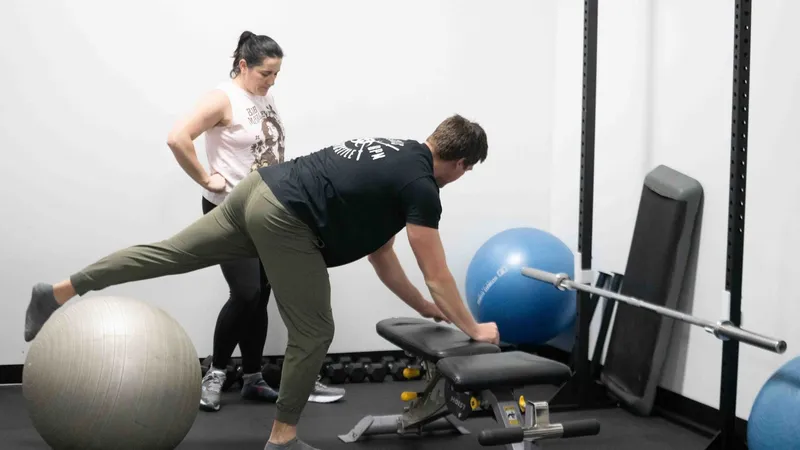
What you give up is the coach’s uninterrupted attention for 60 straight minutes. What you keep is a program written for you, someone correcting your form, and someone who notices when you stop showing up. For most people chasing general strength, body composition, or getting back into training, that trade is heavily in their favour. Rehabbing a serious injury or prepping for competition, maybe not. More on how the format works in what is semi-private personal training.
What does a fair rate look like in Edmonton right now?
A fair Edmonton rate is $60 to $90 per session for one-on-one at a staffed private facility, and $35 to $50 per person for semi-private. Below those ranges, ask what is being cut. Above them, ask what you are getting that the published market rate does not include. Both questions have legitimate answers.
Cheap is not automatically bad. A newer trainer building a client base, low rent, or an off-peak slot can all produce a lower price with no drop in coaching quality. What should concern you is a low price attached to a long contract.
Expensive is not automatically bad either. A clinical background, specialized equipment, or a coach whose clients stay for years can justify a premium. What should concern you is a premium justified only by branding.
The tell is whether they will explain the number. Any studio should be able to say, in one sentence, what you get for the rate and why it costs what it costs. If the answer is “come in and we’ll discuss it,” that is a sales process, not a pricing model.
What hidden costs should you ask about before you sign?
Five things routinely change your real cost per session: expiry dates on packages, mandatory assessment or intake fees, separate facility access charges, GST, and auto-renewal terms. None of these are scams. All of them are frequently left out of the number you are quoted on the phone.
Expiry dates. The YMCA states its packages are non-refundable and expire one year from purchase. That is disclosed and reasonable. But buy 20 sessions, use 14, and your effective rate goes from $64.90 to $92.71. Ask what happens to unused sessions.
Intake and assessment fees. The City of Edmonton charges non-members $139 for an Exercise Consultation covering goal setting, assessment, program design, and equipment orientation. That is a separate line item before your first training session. Ask whether assessment is included or billed.
Facility access. City of Edmonton member rates apply only to Continuous Monthly and Annual Pass holders. The $56 member rate is real, but it assumes you already pay for a pass. Compare the all-in monthly figure, not the session rate. I go deeper on that in personal trainer vs gym membership.
GST. Personal training is a taxable service in Alberta. A business must register for and charge GST once its taxable revenue passes $30,000 in a single calendar quarter or over four consecutive quarters, which any established studio has. Ask whether the quoted rate includes tax. Five percent on a $1,298 package is $64.90, or one extra session’s worth.
Auto-renewal and cancellation. Ask how much notice is required to pause or cancel, and whether the package renews automatically. Get the answer before you give anyone a card number.
How do you judge value instead of just price?
Divide the total you paid by the number of sessions you actually attended, not the number you bought. Then ask whether you are stronger, more consistent, and less confused about what to do than you were 12 weeks ago. A $43 session you skip costs infinitely more per result than a $90 session you show up for.
This is the part the industry is least honest about. Adherence decides outcomes, and price affects adherence in both directions. Too expensive and you quit for financial reasons. Too cheap and you do not value the appointment enough to protect it in your calendar.
Three questions that predict value better than the rate does:
- How long do their clients stay? Long tenure means the coaching works and the price is sustainable. Nobody keeps paying for something that is not working.
- Is there a real program, or just a workout? A workout makes you tired today. A program makes you stronger in March. You are paying for the second one.
- Does anyone notice when you disappear? Accountability is the least glamorous and most valuable thing you are buying.
If you are still weighing whether coaching makes sense at all, I have laid out that case separately in is a personal trainer worth it.
What does training at MOV-U cost?
I am not going to put a number in a blog post that might be out of date by the time you read it. Instead, contact us and you will get the current rate, in full, before anyone asks you to commit to anything. That is the whole point of an article arguing for pricing transparency.
MOV-U is a semi-private personal training and nutrition studio at 4906 93 Ave NW in Edmonton. Reach us at 587-815-8538 or through the contact page. To see how we work before talking money, start with a free consultation, or read our personal training page and the new client information.
Ask us the same questions you should be asking every studio in this city. If we cannot answer them clearly, keep shopping.
Questions to ask before you hand over a credit card
Take this list to every studio you call. The answers, and how readily they come, will tell you more than any price comparison.
- What is the rate per session, and does that include GST?
- How many people does the coach work with at once during my session?
- Who writes my program, and is it different from the person beside me?
- What certification does my trainer hold, and what were the prerequisites for it?
- Do sessions expire? What happens if I miss one?
- Is there a separate assessment, intake, or facility access fee?
- What is the cancellation policy, and does anything auto-renew?
- Can I try a session before committing to a package?
Frequently asked questions
How much does a personal trainer cost per hour in Edmonton?
One-on-one training runs roughly $60 to $90 per hour at a private Edmonton studio, and $70 to $76.50 for non-members at a City of Edmonton facility. In-home trainers quote $55 to $80 for 55-minute sessions. Semi-private formats cost considerably less per person.
Is semi-private training actually cheaper than one-on-one?
Yes, substantially. The City of Edmonton charges non-members $43 per session for semi-private in a 10-pack against $70 for private, about 39% less. Industry pricing guidance puts semi-private at 40 to 60% of a trainer’s one-on-one rate.
Do package deals really save money?
Somewhat, but less than most people assume. The City of Edmonton’s 10-session package saves about 8.5% versus a single session. The YMCA’s 20-session package is about 13% below its five-session rate. A national Canadian guide puts typical private-market discounts at 10% for 10 sessions and 20% for 20. Weigh that against the risk of unused sessions expiring.
Why won’t Edmonton studios publish their prices?
Usually because they want a conversation before you see a number, either to explain what is included or to sell you. Some of that is legitimate, since a rate without context is misleading. Most of it is not. Any studio should tell you the rate over the phone if you ask directly.
How many sessions a week do I need?
That depends on your goal, your training history, and your recovery capacity, and any honest coach will want to know all three before answering. What matters more than frequency is consistency over months. Two sessions a week you never miss beats four you attend half the time.
Are personal training sessions subject to GST in Alberta?
Yes. Personal training is a taxable service, and any business past the Canada Revenue Agency’s $30,000 small-supplier threshold must charge GST. In Alberta that is 5% with no provincial sales tax. Always confirm whether a quoted rate is before or after tax.
Written by Mackenzie Clarke, Owner-Operator of MOV-U, a semi-private personal training and nutrition studio in Edmonton, Alberta. All third-party rates cited were published by the named organizations at the time of writing and are subject to change.